

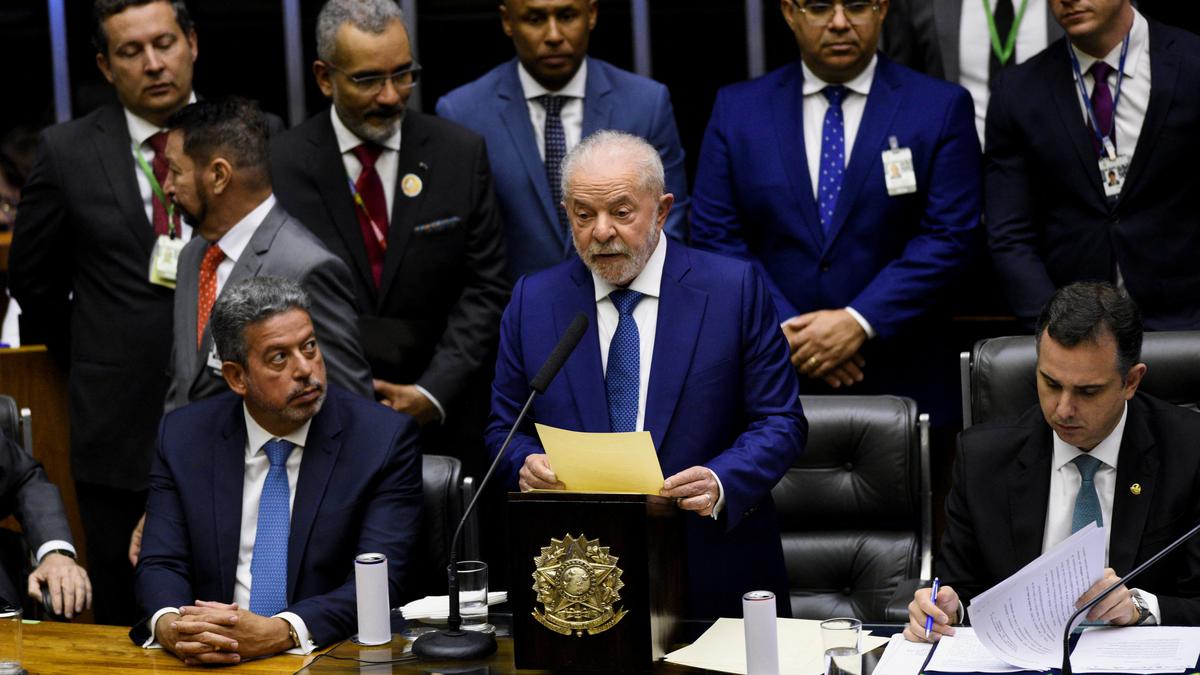
Brazil’s new President Luiz Inacio Lula da Silva delivers a speech after being sworn in at the National Congress, in Brasilia, Brazil, January 1, 2023.
| Photo Credit: Reuters
(This article forms a part of the View From India newsletter curated by The Hindu’s foreign affairs experts. To get the newsletter in your inbox every Monday, subscribe here.)
Last week, the world saw the return of three prominent leaders to power — one in India’s periphery, one in its extended neighbourhood and the third in the Americas — who could potentially reshape the domestic and foreign policy trajectories of their respective countries. In Nepal, India’s Himalayan neighbour, Pushpa Kamal Dahal, better known as ‘Prachanda’, was sworn in as the Prime Minister on December 26. In Israel, Benjamin Netanyahu, the country’s longest serving Prime Minister, returned to the top job with support from far-right and ultra-orthodox allies. In faraway Brazil, leftist Workers Party leader and former President Luiz Inácio Lula da Silva, who defeated far-right President Jair Bolsonaro in the October 30 run-off, took oath on January 1.
These leaders face different kinds of challenges in running their countries. In Nepal, Prachanda’s party, the Communist Party of Nepal (Maoist-Centre), was part of a pre-poll six-party coalition led by the Nepali Congress (NC), which won just about a majority in the parliamentary elections held in November. But post poll, he quit the alliance and joined hands with the leading Opposition party, the Communist Party of Nepal (Unified Marxist-Leninist), led by former Prime Minister K.P. Oli, and six other parties, and secured the post of Prime Minister. His biggest challenge is to keep his difficult coalition together in a country that’s known for its fractious and complex politics while addressing Nepal’s enormous economic and political challenges. In this detailed profile of Prachanda, Srinivasan Ramani traces the evolution of the former underground revolutionary into one of the Kathmandu elite wedded into the status quo.
In Israel, Mr. Netanyahu’s return clearly marks a shift in the country’s domestic politics. His allies, such as Religious Zionism, United Torah Judaism and Shas, want the government to rewrite the Jewish nation’s state-religion balance, empower Parliament to override the judiciary and expand Jewish settlements in the occupied Palestinian territories. Amid worries that the coalition would endanger Israel’s complex democracy further, Mr. Netanyahu has committed himself to implementing the coalition agreement. “While the coalition seems determined to remake Israel’s politics internally and deepen the occupation and subjugation of the Palestinians externally, it could also quicken the country’s fall into an elected Jewish theocracy,” The Hindu warns in this editorial.
In Brazil’s Lula’s biggest challenge is to live up to the expectations of the voters after four rough years of Bolsonaro. During Bolsonaro’s reign, Brazil saw the economic progress it witnessed under the Lula years vanish and the amazon forest shrink. Lula has to restore the public faith in the government, address the chronic problem of corruption, put the economy back on track and tackle inequality. In this editorial published immediately after Lula’s win, The Hindu wrote, “The road ahead is bumpy, but his record shows that he is a clever politician and an able administrator who might well be able to negotiate his way past Brazil’s status quoist elites to bring about incremental changes.”
Neighbourhood Watch
China announced on Friday that its current envoy to the U.S. will become the country’s next Foreign Minister, part of a broader diplomatic reshuffle set to unfold in coming months. Qin Gang, 56, a veteran diplomat, earlier served as the chief protocol officer for President Xi Jinping, and was handpicked by Mr. Xi in 2021 to serve as Ambassador in Washington amid growing tensions in the relationship, Ananth Krishnan reports from Beijing.
Meanwhile, Chinese President Xi held talks with Russia’s embattled President Vladimir Putin through a video call in which both leaders committed themselves to deepening strategic ties between their countries. “In the context of growing geopolitical tensions, the importance of the Russian-Chinese strategic partnership as a stability factor is growing,” Mr. Putin told Mr. Xi. In his comments, the Chinese leader said Beijing “stands ready to join hands with Russia and all other progressive forces around the world who oppose hegemony and power politics.”
The Ministry of External Affairs said in a statement that India is committed to addressing “all humanitarian matters, including those pertaining to prisoners” with Pakistan. The statement came after India and Pakistan exchanged lists of prisoners on Sunday in accordance with the 2008 Agreement on Consular Access, under which the exchange takes place every year on January 1 and July 1. The Government has called for early release and repatriation of civilian prisoners, missing Indian defence personnel, and fishermen along with their boats, from Pakistan’s custody,” the MEA said.
The Top Five
1. In the new evolving world, India needs a new vision
The foundation for this new vision is a harmonious and inclusive society that embraces India’s unique plurality; incrementalism using existing tools, structures and processes may not suffice, write Shashi Tharoor and Praveen Chakravarty.
2. Should India review its position on the Taliban?
In a conversation moderated by Suhasini Haidar, Amar Sinha and Tara Kartha discuss India’s policy choices on the Taliban-controlled Afghanistan.
3. India’s dilemmas in an Asian century
For status quoist India, the rise of the Asian century might turn out to be too seeped in harsh realpolitik for its comfort, writes Happymon Jacob
4. Abdulla Yameen | An anti-India hardliner
The former Maldives President, who was spearheading an ‘India Out’ campaign, faces political uncertainty after he was sentenced to 11 years in jail for corruption, writes Meera Srinivasan.
5. Eli Cohen | From intel to diplomacy
Israel’s new Foreign Minister faces the challenge of preserving and expanding the country’s foreign relations irrespective of the far-right turn in its domestic politics, writes Stanly Johny